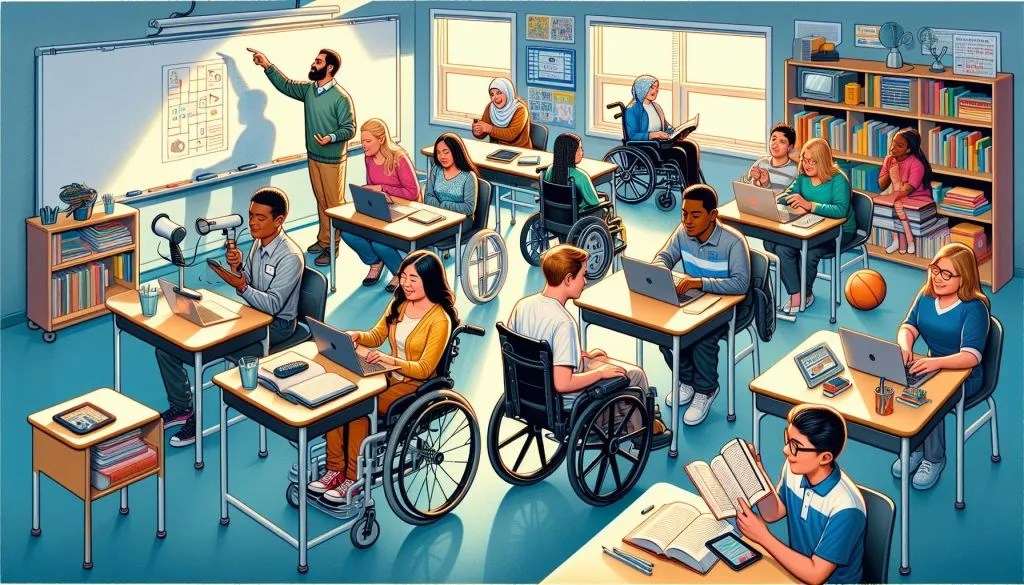
The inclusion of special needs students in the general education classroom is becoming increasingly common and is a positive move toward an equitable higher education system. Even though this practice is supported by various international conventions and local laws and policies, it poses several challenges for both educators and students. As a university lecturer I have had the opportunity to instruct students with special needs on several occasions. My experiences, coupled with a review of relevant literature, offer valuable insights into the difficulties associated with including special needs students in the general education classroom. In this reflective article, I will examine my personal experiences teaching special needs students, the legal frameworks that support teaching special needs students, the legal and institutional frameworks that support inclusion, and the challenges faced by educators in implementing inclusive education in higher education institutions. This reflection is grounded in both theoretical perspectives and practical considerations, with a view toward improving practices and policies to support students with special needs in higher education.
Legal Framework and Inclusion in Higher Education
In Jamaica, where I teach, several legal frameworks govern the education of special needs students, beginning with the Jamaica Constitution (1962), which guarantees every child, abled or disabled, the right to publicly funded tuition in a public institution. The Education Act (1982) empowers the Minister of Education to provide education for special needs students. The Disabilities Act (2014) further ensures the rights of people with disabilities to receive necessary educational support in the least restrictive environments. The Ministry of Education’s Policy on Special Needs (2017) primarily addresses special-needs students in lower educational levels but also includes post-secondary and higher education. It mandates that post-secondary institutions must not exclude qualified students due to disabilities and should encourage voluntary, confidential self-disclosure to facilitate reasonable accommodation. This ensures students can perform optimally and equitably. Additionally, students with disabilities should not face discriminatory assessments, and support should be provided through student services to promote academic success. Additionally, educators working with special needs students must complete at least 15 hours of professional development in special education every three years.
These frameworks align with international standards such as the United Nations Convention on the Rights of Persons with Disabilities (2006) and are essential for promoting educational access for all students. However, despite these progressive legal structures, implementation often faces significant barriers. For instance, a wheelchair-bound student was denied registration at a Jamaican high school (“Check Another School”, Clarendon Principal Tells Relative of Student With Disability, 2023), highlighting ongoing systemic challenges. Although the Ministry of Education’s efforts to retrofit schools with accommodation like ramps and lifts are commendable, much work remains to create truly inclusive educational environments.
Personal Reflections on Teaching Special Needs Students
Throughout my teaching career, I have encountered several students with disabilities. Two students with hearing impairments and one with a speech disability stand out in my memory. One of the hearing-impaired students was accompanied by an interpreter, while the other attended class independently. The student with speech disability was noticeably attentive but struggled to engage fully in class discussions and group activities. Teaching these students has brought both fulfillment and frustration. On the one hand, it is rewarding to know that these students have the opportunity to pursue higher education. On the other hand, our current teaching methods and classroom environments are not always conducive to their full participation. Group work, for instance, is a common feature in the courses that I teach, and it often poses communication challenges between students with and without disabilities. Additionally, many general education faculty members, including myself, often lack the training to modify our teaching approaches to support these special needs students effectively.
I have noticed that while some students with disabilities manage to perform satisfactorily, others struggle to keep up with the demands of the coursework. These observations reflect a broader issue in higher education: the assumption that providing access is enough, without considering the quality of the experience or the support students need to succeed academically and socially.
Challenges in Inclusive Higher Education
Higher education institutions face multiple challenges with offering services to special needs students. Many institutions struggle to provide accessible physical spaces and online platforms that accommodate students with disabilities (Kirno & Premchaiporn, 2022). This can include inaccessible buildings, limited assistive technology, and poorly designed course materials that are not compatible with screen readers or other assistive devices.
A significant challenge I have faced, and one that is echoed in literature, is the lack of adequate training for educators in handling special needs students in the general education classroom. According to Collins et al., (2018) in their study on inclusive education in higher education, many academic staff members are not formally trained to address the needs of students with physical disabilities. This results in gaps in awareness and support, making it difficult for these students to thrive academically. Additionally, Pillai and Devamanokari (2023) highlight the difficulty that general educators experience when assessing students with disabilities. Teachers often do not have the adapted assessment tools, and this can lead to inaccurate evaluations of students with special needs. These issues are compounded by teachers’ attitudes toward special needs students in the general education classroom. Teachers’ attitudes towards inclusive education significantly influence their success. Bala (2021) found that while 24% of teachers had a positive attitude, the majority had neutral or negative attitudes, driven by concerns like large class sizes and the need for individualized attention. Such negative attitudes often stem from inadequate training and awareness of legal frameworks for special needs students. Although laws like the Disability Act (2004) and the Policy on Special Needs (2017) mandate accommodations, their interpretation and implementation can vary widely across institutions and instructors, leading to inconsistent student experiences (Gökdağ & Ünlü, 2023).
Students with special needs face their own challenges in the general education classroom. Special needs students require individualized support services such as tutoring and specialized counseling, but limited institutional resources often result in long waiting times or inadequate accommodations (Zurina Ismail et al., 2023). For students with severe disabilities like autism spectrum disorder (ASD), challenges are even more pronounced. Al Jaffal (2022) noted that many general education teachers feel unprepared to adapt curricula and manage behavior for students with ASD, causing frustration and undermining inclusion. Additionally, special needs students may face social isolation due to stigmas or a lack of understanding from peers, negatively impacting their academic and emotional well-being (Bruefach & Reynolds, 2021).
Inclusive Education in Practice: What Needs to Change?
In reflecting on my own experiences and the literature, while the legal frameworks supporting inclusion are well-intentioned, there is a significant gap between policy and practice. I put forward a few recommendations to improve the services offered to special needs students in higher education.
First, training for educators needs to be expanded. Higher education teachers require formal training in inclusive practices as outlined in the Policy on Special Education (2017). This training should encompass both theoretical knowledge and practical strategies for adapting instruction and assessments to accommodate students with disabilities. The improvement of inclusive education requires collaboration between general and special education professional as suggested by Al Jaffal (2022). This might include team-teaching models or special education staff in general classrooms, offering general educators the support needed to accommodate students with disabilities. Differentiated instruction (DI) is a common buzzword in education, but in practice the gap needs to be filled. Strogilos (2018) demonstrated differentiated instruction’s effectiveness in supporting students with disabilities in inclusive settings. Incorporating DI into higher education practices ensures all students, regardless of ability, can access the curriculum. Creating truly student-centered learning environments requires more than physical accessibility. It involves rethinking course design, instruction delivery, and assessment methods (Howard, 2023). For example, offering alternative assignment formats or extra time for assessments can effectively create more inclusive classrooms.
Finally, the attitudinal shifts necessary to foster an inclusive culture in higher education may take time but are key to its success. This involves raising awareness among faculty and students about the importance of diversity and inclusion (Asres, 2019). Universities should promote positive attitudes towards students with disabilities through workshops, discussions, and policy changes prioritizing inclusiveness.
Conclusion
The inclusion of special needs students in the general education classroom in higher education is a complex but necessary goal. While legal frameworks provide a foundation for inclusive education, much work remains to be done in terms of implementation. As my personal experiences and the literature suggest, educators need more training, support, and resources to meet the needs of students with disabilities. By fostering collaboration, adopting differentiated instruction, and shifting attitudes towards inclusion, we can move closer to creating higher education environments where all students can thrive. In reflecting on these issues, I am reminded that inclusion is not a destination but an ongoing process. It requires continual reflection, adaptation, and commitment from all members of the educational community—teachers, administrators, students, and policymakers alike.
References
Al Jaffal, M. (2022). Barriers general education teachers face regarding the inclusion of students with autism. Frontiers in Psychology, 13(5097). https://doi.org/10.3389/fpsyg.2022.873248
Asres, G. W. (2019). The attitude of students without disabilities towards the integration of students with disabilities into the regular classroom: The case of selected primary schools of South Gondar administrative towns, Ethiopia. The International Journal of Humanities & Social Studies, 7(1). https://doi.org/10.24940/theijhss/2019/v7/i1/hs1901-023
Bala, D. I. (2021). Attitude of teachers towards inclusive education in relation to their perceived self-efficacy to teach in inclusive classroom. Turkish Journal of Computer and Mathematics Education (TURCOMAT), 12(10), 7223–7228. https://doi.org/10.17762/turcomat.v12i10.5611
Bruefach, T., & Reynolds, J. R. (2021). Social isolation and achievement of students with learning disabilities. Social Science Research, 104, 102667. https://doi.org/10.1016/j.ssresearch.2021.102667
“Check another school”, Clarendon principal tells relative of student with disability. (2023, July 17). News | Jamaica Gleaner. https://jamaica-gleaner.com/article/news/20230717/check-another-school-clarendon-principal-tells-relative-student-disability
Collins, A., Azmat, F., & Rentschler, R. (2018). ‘Bringing everyone on the same journey’: Revisiting inclusion in higher education. Studies in Higher Education, 44(8), 1475–1487. https://doi.org/10.1080/03075079.2018.1450852
Convention on the Rights of Persons with Disabilities (CRPD) | Division for Inclusive Social Development (DISD). (n.d.). https://www.un.org/development/desa/disabilities/convention-on-the-rights-of-persons-with-disabilities.html
The Disabilities Act. (2014). Jamaica Parliament. https://www.japarliament.gov.jm/attachments/341_The%20Disabilities%20bill%202014%20No.13.pdf
The Education Act. (1984). Ministry of Justice Jamaica. https://laws.moj.gov.jm/library/statute/the-education-act
Gökdağ, A., & Ünlü, Ö. (2023). Higher Education Instructors With Special Needs Students: Challenges And Recommendations. Necatibey Eğitim Fakültesi Elektronik Fen ve Matematik Eğitimi Dergisi, 17(Özel Sayı), 471–507. https://doi.org/10.17522/balikesirnef.1359140
Howard, K. B. (2023). Supporting learners with special educational needs and disabilities in the foreign languages classroom. Support for Learning, 38(3), 154–161. https://doi.org/10.1111/1467-9604.12449
The Education Act. (1984). Ministry of Justice Jamaica. https://laws.moj.gov.jm/library/statute/the-education-act
Kirno, S., & Premchaiporn, N. (2022). Accessibility of persons with disabilities to study in
higher education institutions. Ilomata International Journal of Social Science, 3(1), 392–401. https://doi.org/10.52728/ijss.v3i1.414
Pillai, A., & Devamanokari, K. (2023). Academic assessment by general educators in inclusive schools on special needs. International Journal of Science and Research Archive, 8(1), 459–464. https://doi.org/10.30574/ijsra.2023.8.1.0090
Policy on special education: Access, equity and relevance. (2017). Ministry of Education, Jamaica. https://planipolis.iiep.unesco.org/sites/default/files/ressources/jamaica_policy_special_education.pdf
Strogilos, V. (2018). The value of differentiated instruction in the inclusion of students with special needs/ disabilities in mainstream schools. SHS Web of Conferences, 42(42), 00003. https://doi.org/10.1051/shsconf/20184200003
Zurina Ismail, Z. I., Ahmad, A. A., Zakaria, A., & Muhamad Zaki, N. H. (2023). Voices of special need students at public higher learning institutions: a wishlist to ponder. International Journal on E-Learning and Higher Education, 19(3), 69–86. https://doi.org/10.24191/ijelhe.v19n3.1935


 Marie Bradford EdD.
Leave a comment